Compare with 1 courses
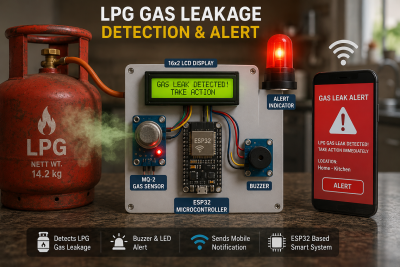
 LPG Gas Leakage Detection & Alert

LPG Gas Leakage Detection & Alert

This project is an intelligent LPG gas leakage detection and alert system that continuously monitors gas levels using a gas sensor. When a gas leak is detected, the system instantly activates a buzzer and warning indicator to alert nearby people, helping prevent accidents, fire hazards, and gas-related emergencies. It is suitable for homes, kitchens, laboratories, and industrial environments, providing enhanced safety through real-time monitoring and rapid alerts.

4999 ₹

7000 ₹
Learn more
Has discount
Expiry period 4 Months
Made in English
Last updated at Sun Jun 2026
Level
Beginner
Total lectures 0
Total quizzes 0
Total duration 0 Hours
Total enrolment 0
Number of reviews 0
Avg rating
Short description This project is an intelligent LPG gas leakage detection and alert system that continuously monitors gas levels using a gas sensor. When a gas leak is detected, the system instantly activates a buzzer and warning indicator to alert nearby people, helping prevent accidents, fire hazards, and gas-related emergencies. It is suitable for homes, kitchens, laboratories, and industrial environments, providing enhanced safety through real-time monitoring and rapid alerts.
Outcomes
  • Understand the working principle of LPG gas detection systems.
  • Learn how gas sensors such as MQ-2 or MQ-6 detect combustible gases.
  • Interface gas sensors with Arduino microcontrollers.
  • Design and implement a real-time gas leakage monitoring system.
  • Configure buzzer and LED alert mechanisms for safety applications.
  • Analyze sensor data and set threshold values for gas detection.
  • Develop practical skills in embedded systems and electronics.
  • Troubleshoot and optimize sensor-based safety projects.
  • Understand the importance of industrial and household safety automation.
  • Enhance project development skills for IoT and smart safety applications.
  • Upgrade the system with GSM, Wi-Fi, or IoT-based remote alert features.
  • Build a complete working prototype for academic and industrial applications.
Requirements
  • Arduino Uno / Arduino Nano
  • MQ-2 or MQ-6 Gas Sensor
  • Buzzer
  • LED Indicators (Red/Green)
  • 220Ω Resistors
  • Breadboard
  • Jumper Wires
  • USB Cable
  • Power Supply (5V)